Not sure whether the small snake by your steps is a baby copperhead? Look at the tail first. NC State Extension says young copperheads usually have greenish-yellow or yellow tail tips. Then look for the copperhead pattern: dark hourglass-shaped bands that are narrow across the back and wide on the sides, over a tan, brown or pinkish background.
Copperheads do not lay eggs, so every baby copperhead snake you see was born alive, in late summer or early fall according to the North Carolina Wildlife Resources Commission (NC Wildlife). The young have less venom than adults, and like adults they can bite without injecting any venom at all. That is why NC Wildlife calls them no more or less dangerous than a grown copperhead.
Is the snake inside your house or garage right now? Keep people and pets out of that room and call.
What Does a Baby Copperhead Look Like?
Every sign in this list can be seen from several steps away. You never need to get closer to check, and a snake you cannot name should be treated as venomous.
- Tail tip: NC State Extension says juveniles usually have a greenish-yellow or yellow tail tip. Usually is not always, so a plain tail does not clear a snake by itself. NC Wildlife notes that young water snakes lack the yellow tip.
- Hourglass bands: a young copperhead already wears the adult pattern, shaped like an hourglass or dumbbell. NC Wildlife says patterns vary, but nearly all copperheads have at least some complete hourglass bands.
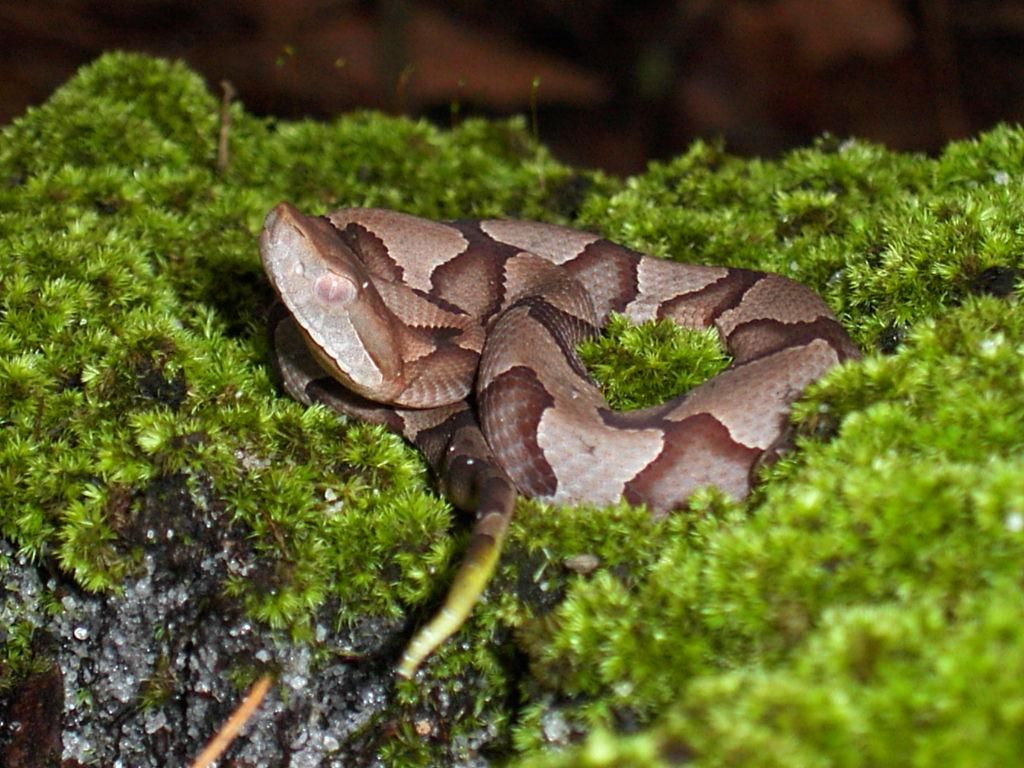
The rest of the look, from the coppery head with its dark eye line to the base color, is the same as a grown snake's. Our copperhead removal page lists what a copperhead looks like as an adult, including why head shape is a poor test.
Juvenile Copperhead vs Adult
The tail tip is the difference NC State Extension singles out for juveniles. Size is the other obvious one, and it can fool people: a snake that small looks easy to pick up and move. Treat a small banded snake with the same caution as a big one.
Snakes That Look Like Copperheads in North Carolina
Many small snakes people take for baby copperheads turn out to be a harmless copperhead look-alike, and small brown snakes are a frequent mix-up. Killing the snake to be safe is the riskier choice: NC Wildlife says a large percentage of copperhead bites happen when people try to capture, kill or handle them.
These are the look-alikes NC State Extension describes in its guide to harmless North Carolina snakes. Its range notes put every snake in this table in the Piedmont, where Mooresville sits.
| Snake | What it looks like | How it differs from a copperhead |
|---|---|---|
| DeKay's brown snake | Up to about 18 inches, with a pale stripe down the back and paired dark blotches | A stripe and paired spots, not hourglass bands; usually does not bite |
| Eastern rat snake (young) | Light gray or brown with darker brown or gray blotches | Blotches, not hourglasses; adults turn black with a white chin (see black rat snakes) |
| Black racer (young) | Gray with light brown splotches | Splotches, not bands; adults are all black and usually race away |
| Corn snake | Glossy red, orange, gray or brown with reddish-brown markings | Each marking is outlined with black |
| Mole kingsnake | Light brown, red or tan with darker diamond-like blotches; young are often brighter | Diamonds and blotches, not hourglasses |
| Northern water snake (young) | Dark cross bands near the head, then alternating blotches; young are boldly patterned | Young ones lack the yellow tail tip (see Lake Norman snakes) |
| Eastern garter snake | A light stripe down the middle of the back and fainter stripes on each side | Stripes run along the body instead of across it |
| Eastern hognose snake | Black and gray are common colors in North Carolina | Puts on a show when bothered and may roll over and play dead |
You may also see the eastern milk snake on look-alike lists. NC State Extension says it lives mainly in the mountains of North Carolina, so it is an unlikely find in Mooresville. For every species in the state, see our guide to snakes in North Carolina.
Tip: judge the pattern, not just the tail. Blotches, stripes or diamonds instead of hourglass bands point toward one of these harmless snakes. If you still cannot tell, treat it as a copperhead and leave it alone.
Baby Copperhead vs Brown Snake
A tiny brown snake in a woodpile or in front of the mower is often a DeKay's brown snake rather than a baby copperhead. NC State Extension describes DeKay's brown snake as reaching about 18 inches, with a pale stripe down the center of the back and paired dark blotches along the body. Young ones may show a light half-collar behind the head, and brown snakes usually do not bite when cornered.
A young copperhead usually has the yellow tail tip, and its crossbands pinch narrow over the back instead of forming a center stripe.
Corn Snake vs Copperhead
Corn snakes are often reddish, so people expect a copperhead. NC State Extension describes a glossy red, orange, gray or brown snake with reddish-brown markings outlined with black. Look for those black outlines. A copperhead's bands are chestnut brown and narrow across the middle of the back.
Garter Snake vs Baby Copperhead
Garter snakes are mostly stripes. NC State Extension describes a light stripe down the center of the back with a less defined stripe on each side, running the length of the body. A copperhead's bands cross the body instead. Some garter snakes lack the stripe and show a checkered pattern, so if you cannot tell which you have, keep your distance.
Baby Copperhead Season in NC
Copperheads mate in the spring and fall, and NC Wildlife says each female gives birth to 3 to 14 live young, sometimes as many as 20, during the late summer or early fall. That is the time of year to expect small copperheads around the yard.
A litter can be several snakes, so after you find one small copperhead in late summer, watch where your hands and feet go in leaf litter, pine straw and woodpiles for a while. NC State Extension says copperheads can be found under cover objects. Our prevention guide explains how to keep snakes away by cutting down that cover.
Are Baby Copperheads More Venomous?
No. NC Wildlife answers this one directly: "Even young copperheads can dry bite, but also have less venom than adults, so they're no more or less dangerous than adults." A dry bite is one with no venom injected, and NC Wildlife says copperheads often bite that way in self-defense.
Are baby copperheads poisonous? Strictly speaking, they are venomous, because the venom has to be delivered by a bite.
A bite from a young copperhead still needs medical care right away. Our copperhead removal page covers what to do after a copperhead bite, for people and for dogs.
Found a Baby Copperhead? What to Do
The steps are the same as for a grown copperhead: back away, bring kids and dogs inside, and give it time to leave. Our page on copperhead removal lists them in order, along with when a call makes sense.
Tip: do not pick it up, trap it or kill it, however harmless a snake that size looks. NC Wildlife links a large share of copperhead bites to exactly that kind of handling.
A baby copperhead in the house or garage is a call, not a form: keep everyone out of that room and phone Mooresville Snake Removal. The form is for things that can wait, such as a shed skin you found or small snakes you keep seeing in the same bed.
Small Snake You Cannot Identify?
Call (844) 595-3326 if the snake is inside or in the way. If it already left, the form is fine.
Get Free EstimateBaby Copperhead Questions
Can a baby copperhead kill you?
It is very unlikely. Young copperheads carry less venom than adults, NC Wildlife says, and it does not consider a copperhead bite life threatening. Any bite still means medical care right away, the same as for an adult.
Do baby copperheads bite?
They can, and a small one is easy to step on or reach for without noticing it in leaves or pine straw. Like adults, they bite to defend themselves, so give it room and it will usually move away on its own.
Do copperheads lay eggs?
No. NC State Extension describes copperheads as live-bearing, and NC Wildlife says the young are born alive in late summer or early fall. If you find snake eggs in a woodpile or garden bed, they came from a different kind of snake.
Can a rat snake and a copperhead breed?
No. NC State Extension says eastern rat snakes and copperheads are not closely related and cannot produce viable offspring.